Hand Planes
Hand planes are the most versatile category in a woodworking toolkit. They smooth, flatten, trim, and shape wood surfaces. The numbering system used by Stanley — the dominant manufacturer of bench planes in the 20th century — runs from No. 1 (the smallest) to No. 8 (a large jointer). Each size is suited to specific tasks.
No. 4 Smoothing Plane
The No. 4 is the everyday bench plane. At roughly 250 mm in length with a 50 mm wide iron, it smooths surfaces after dimensioning and is used for light cross-grain work. Properly tuned and sharpened, a No. 4 leaves a surface that requires no sanding.
No. 5 Jack Plane
The No. 5 jack plane is the workhorse plane for material removal. Its 355 mm length spans minor hollows and removes saw marks from rough stock. Set with a slightly cambered iron, the jack takes thick shavings quickly before a smoother finishes the surface.
No. 6 Fore Plane and No. 7 Jointer
The No. 6 fore plane (450 mm) and No. 7 jointer (560 mm) are used for flattening wide boards and truing the edges of pieces to be glued. The longer sole bridges low spots that shorter planes would follow. For bench-top flattening, a No. 7 with a freshly sharpened iron removes material efficiently.
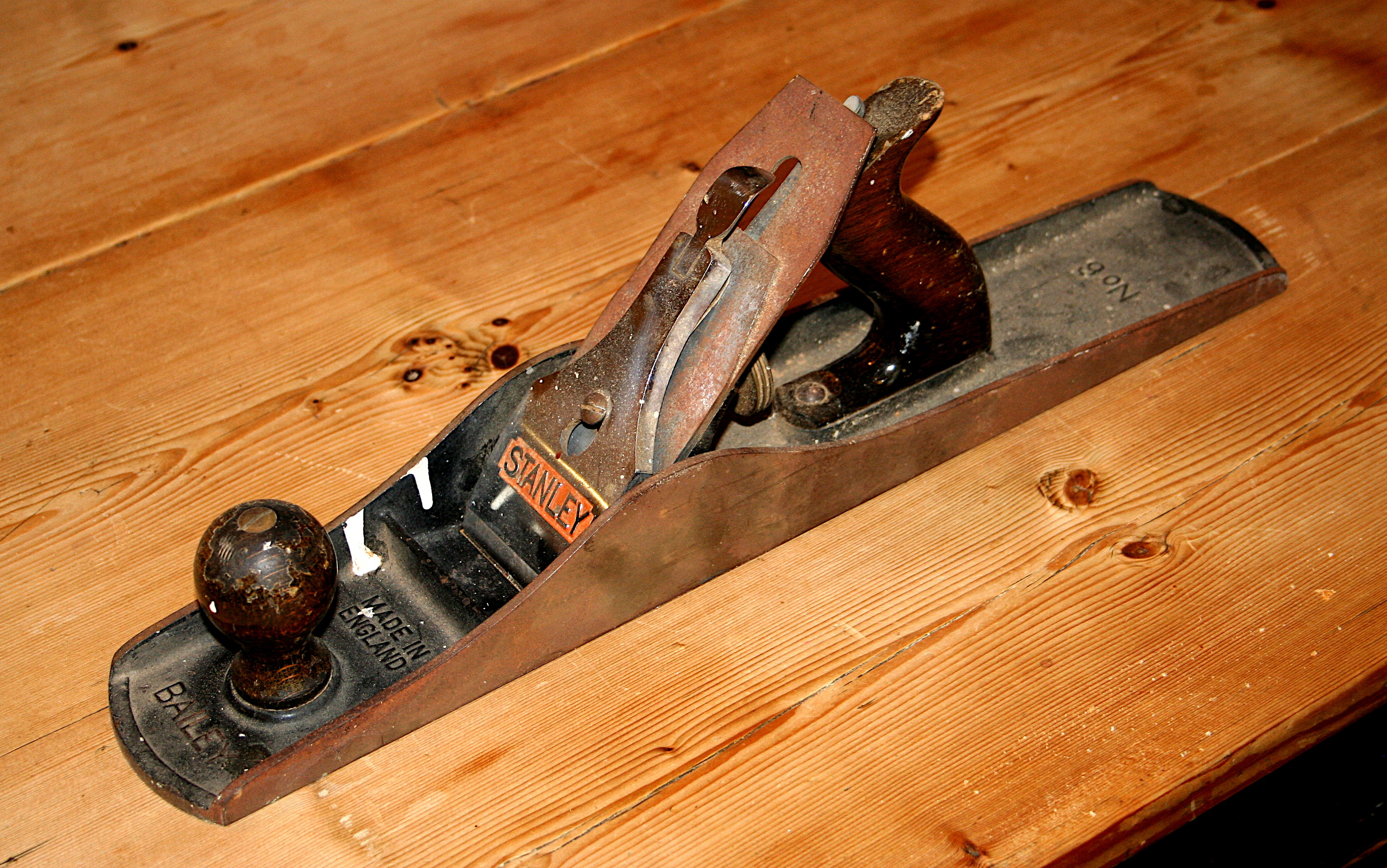
The Stanley No. 6 fore plane — an intermediate size suited to flattening and truing long surfaces. Photo: Wikimedia Commons.
Chisels
Bench chisels are used for chopping mortises, paring joints, and cleaning up saw cuts. A set of six widths — 6, 10, 12, 19, 25, and 32 mm — handles the majority of furniture work. The blade geometry matters: Western bench chisels have a flat back that registers against a marking line; Japanese ura-ura chisels have a hollow back that reduces the sharpening surface.
Steel Choice
Chisels are available in several steel grades. High-speed steel (HSS) and O1 tool steel hold an edge longer than cheaper alloys but require more effort to sharpen. A2 steel, used in many premium chisels from Canadian and American makers, offers a balance between edge retention and ease of sharpening.
Sharpening
No chisel or plane iron is usable straight from the packaging. The back must be flattened on a waterstone or abrasive sheet, and the bevel must be ground to the correct angle (25–30 degrees for general work) before honing. A sharp chisel cuts cleanly; a dull one tears grain and requires excessive force.
Budget more time for sharpening than you expect. A sharp edge is the single largest factor in the quality of hand tool work. Investing in a good 1,000/6,000 combination waterstone pays back immediately in cleaner cuts and less fatigue.
Handsaws
Two types of handsaw cover most workshop needs: a crosscut saw for cutting boards to length, and a tenon saw (or dovetail saw) for joinery work. Tenon saws have a rigid brass or steel spine that prevents the blade from flexing during precise cuts.
Rip vs. Crosscut Geometry
Rip saws have teeth filed to cut along the grain; crosscut saws have teeth with a slight hook and fleam that score the fibres before lifting waste. Using a rip saw to crosscut tears the fibres rather than severing them, producing a rough finish. Modern pull-stroke saws (Japanese-style) cut cleanly in both directions and are more forgiving for beginners.
Marking and Layout Tools
Accurate joinery begins with accurate layout. The minimum marking kit for furniture work includes a marking gauge, a sliding bevel, a combination square, and a marking knife.
- Marking gauge: Sets consistent depth lines for mortises, tenons, and rebates. Mortise gauges have two pins and mark both sides of a mortise simultaneously.
- Combination square: Checks 90-degree and 45-degree angles; the sliding rule can be used as a depth gauge.
- Sliding bevel: Sets and transfers any angle. Used for dovetail slope layout and angled tenon shoulders.
- Marking knife: Scores a line across the grain with precision that a pencil cannot match. The severed fibres guide a chisel or saw cleanly.
Sourcing Hand Tools in Canada
Lee Valley Tools, headquartered in Ottawa, manufactures and imports a broad range of hand tools including their own Veritas-branded planes and marking tools. Their products are well regarded for fit and finish and are available across Canada through retail locations and mail order.
For vintage Stanley planes in usable condition, estate sales, antique markets, and online auctions are reliable sources. A pre-war Stanley No. 4 or No. 5, cleaned and sharpened, performs as well as most new planes at a fraction of the cost.
The Fine Woodworking tool reviews archive provides detailed assessments of hand planes, chisels, and saws that remain useful for comparison shopping.
Tool Maintenance
Hand tools require periodic attention to remain functional. Plane irons and chisel edges should be touched up on a waterstone whenever they begin to tear rather than cut. Plane soles and sides should be kept lightly oiled to prevent rust — a concern in humid Canadian summers. Saw blades should be cleaned of pitch after use and stored hanging or in a canvas roll to prevent tooth damage.
Related Articles
Last updated: May 25, 2026.